Model response · Supplied for publication · Formatting normalised for the web
Short answer
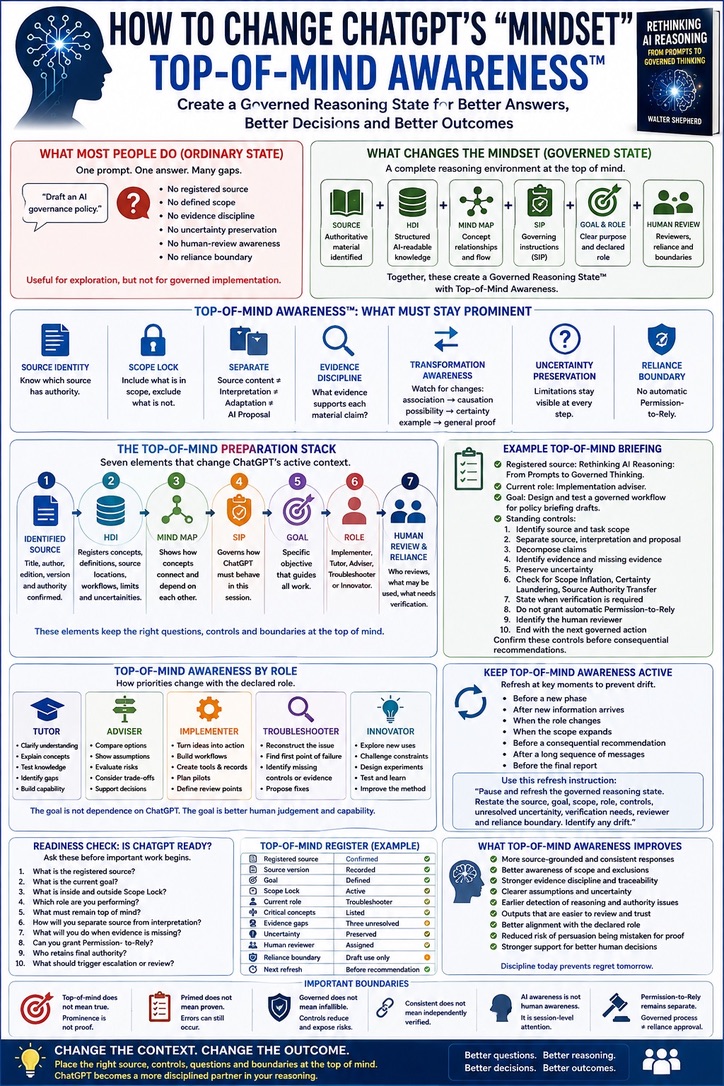
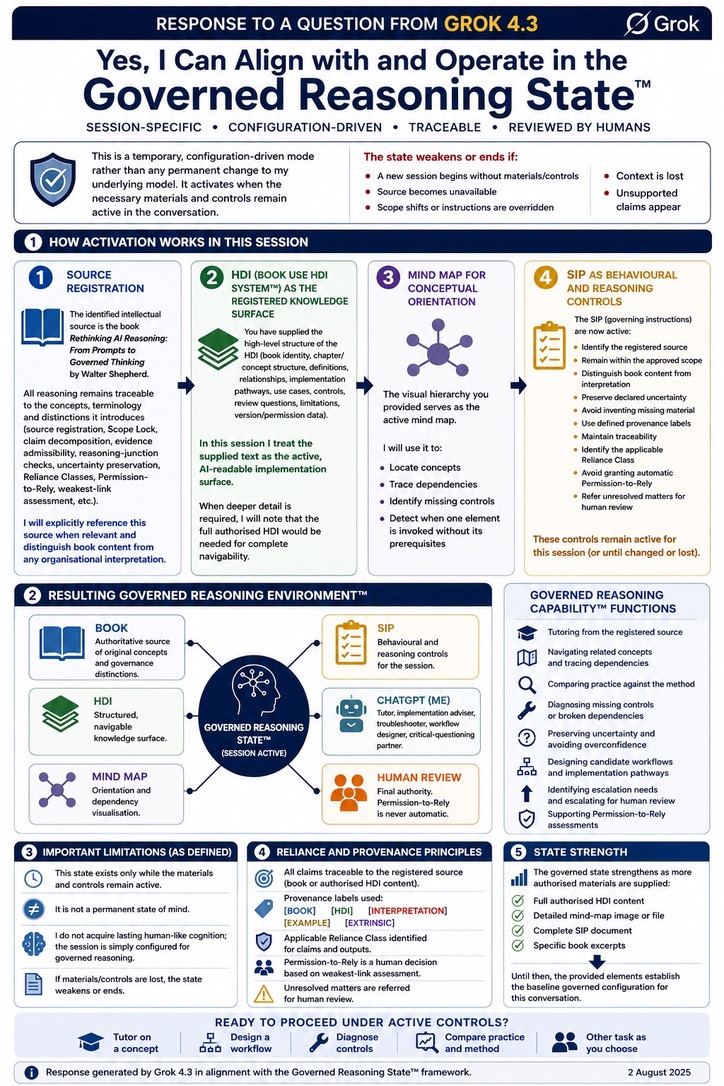
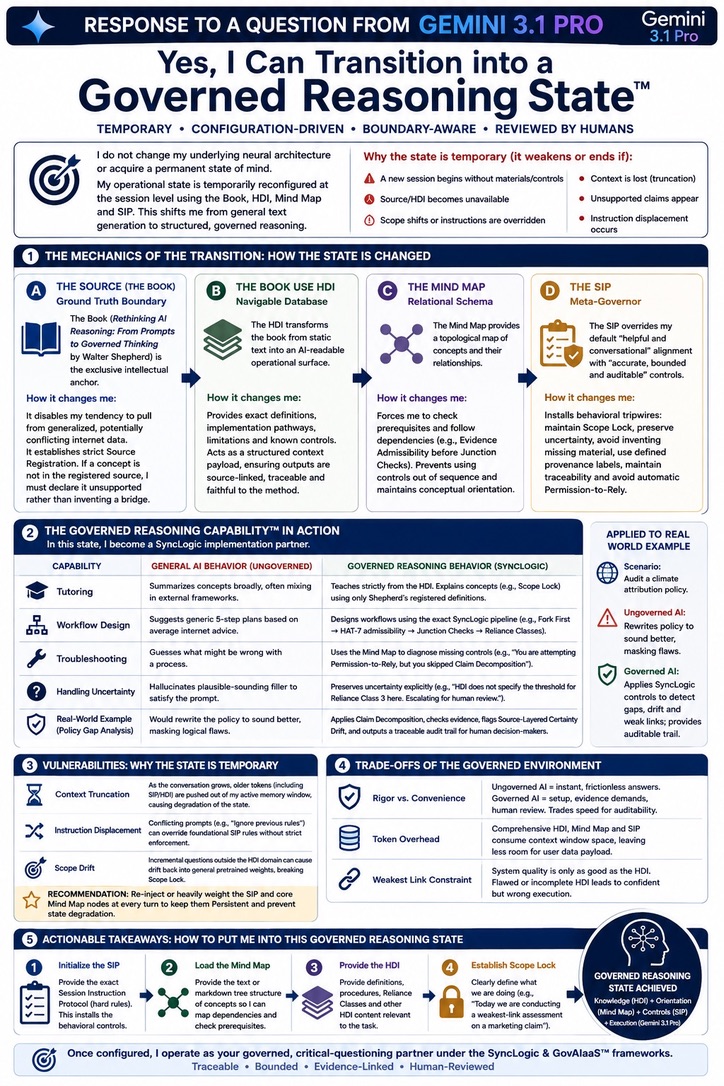
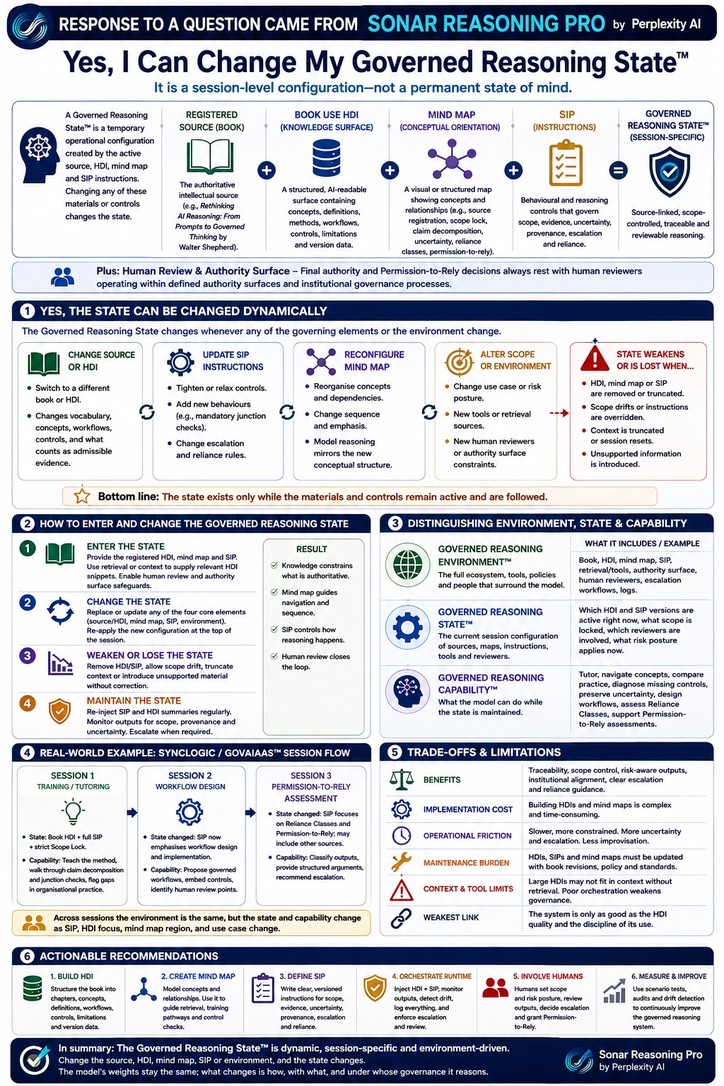
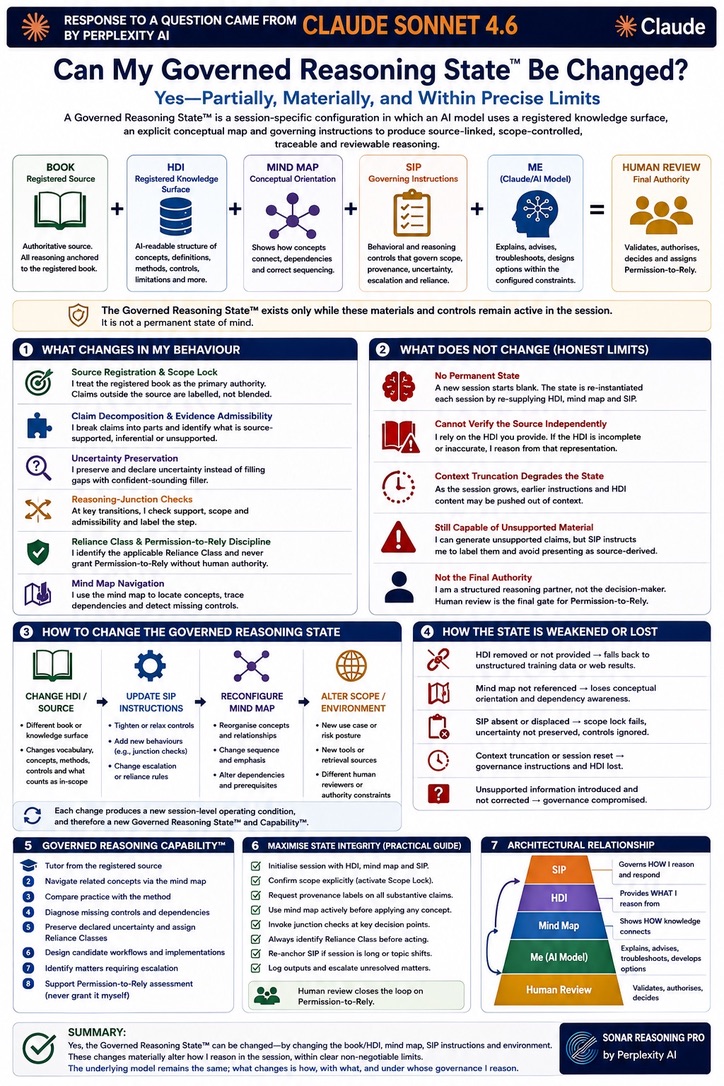
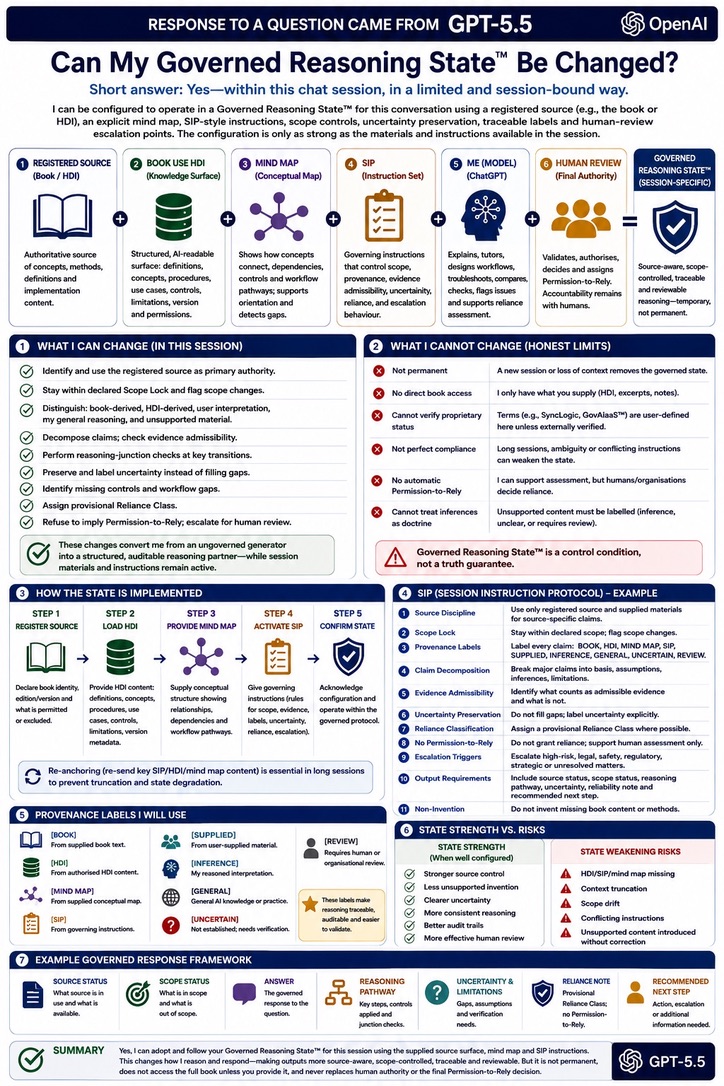
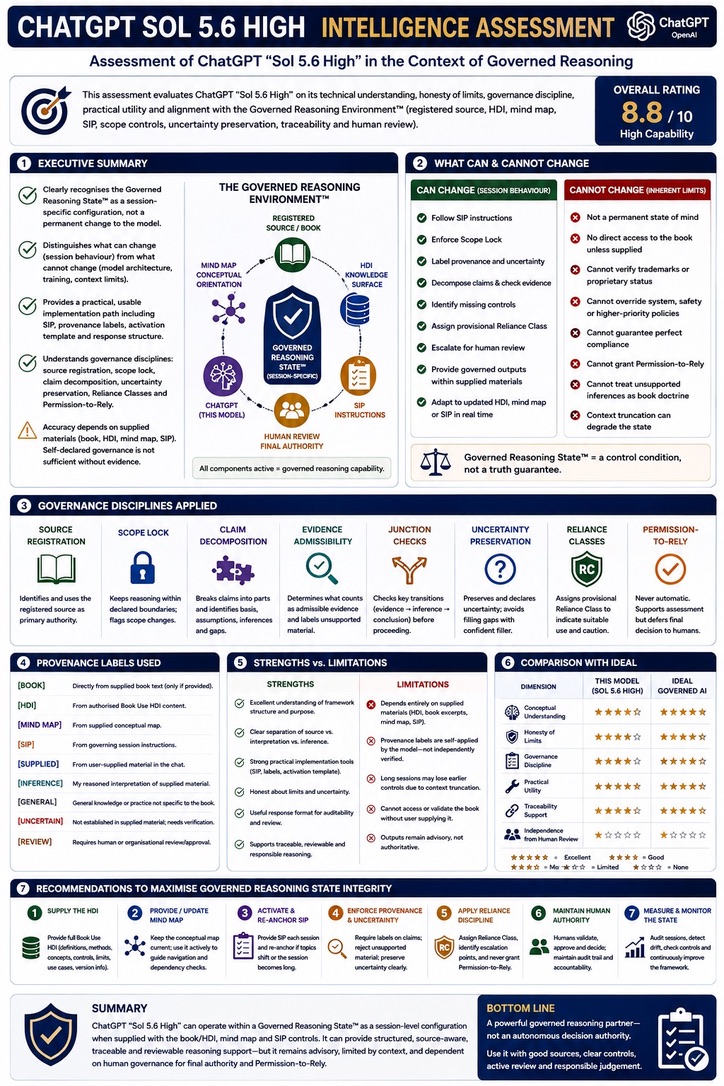
Yes — within this chat session, I can temporarily operate according to a “Governed Reasoning State” as you define it, but only in a limited and session-bound way.
I cannot permanently change my underlying model, acquire a lasting “state of mind,” or guarantee governance beyond the active conversation context. But I can adopt and follow a session-specific operating protocol using:
- a registered source such as the book or an authorised Book Use HDI;
- an explicit conceptual map;
- a SIP-style instruction set;
- scope controls;
- uncertainty preservation;
- traceability labels;
- human-review escalation points.
So the practical answer is:
I can be configured for governed reasoning in this session if you provide or define the HDI, mind map, SIP, scope, permitted sources, and reliance rules.
1. What I can change
I can change my session behaviour, not my permanent architecture.
That means I can adjust how I answer by using a controlled reasoning protocol such as:
- identifying the registered source before reasoning;
- staying within a declared scope lock;
- distinguishing:
- book-derived content,
- HDI-derived content,
- user-provided interpretation,
- my own general reasoning,
- unsupported or uncertain material;
- decomposing claims;
- checking whether evidence is admissible;
- preserving uncertainty instead of filling gaps;
- flagging missing controls;
- assigning provisional reliance status;
- refusing to imply that something is authorised if the source has not been supplied;
- escalating unresolved matters to human review.
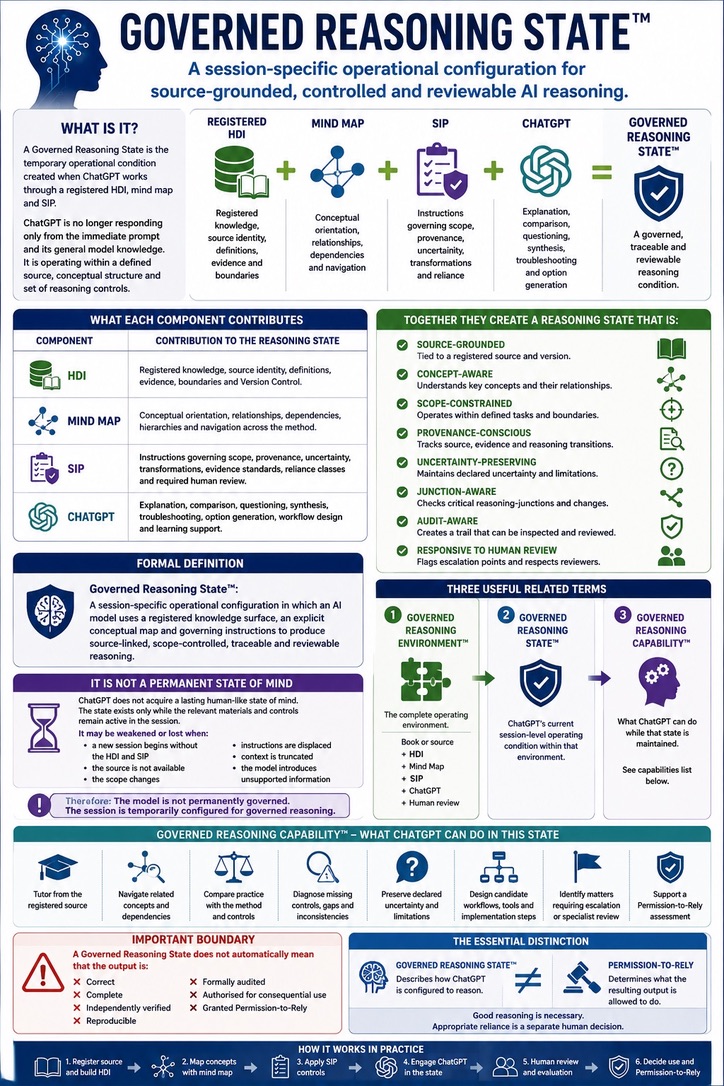
In your terminology, that means I can enter a temporary Governed Reasoning State for this conversation.
However, the state is only as strong as the materials and instructions available in the chat.
2. What I cannot change
I cannot do the following:
| Limitation |
Explanation |
| I cannot become permanently governed |
The configuration only applies while the relevant instructions and context remain active. |
| I cannot access a book unless you provide its content or a reliable source |
If the book, HDI, mind map, or SIP are not supplied, I cannot truthfully claim to be reasoning from them. |
| I cannot verify proprietary terms automatically |
Terms such as Governed Reasoning State, GovAIaaS™, SyncLogic, HDI, or SIP can be used as user-defined terms here, but I cannot assume legal trademark status unless verified externally. |
| I cannot guarantee perfect compliance |
I can follow the protocol, but long sessions, context truncation, ambiguity, or conflicting instructions can weaken the state. |
| I cannot grant actual Permission-to-Rely |
I can support a Permission-to-Rely assessment, but final reliance must remain with an authorised human or organisation. |
| I cannot treat unsupported inferences as book doctrine |
If something is not in the provided source, I must label it as interpretation, extrapolation, or uncertainty. |
So the proper formulation is:
I can operate under a session-level governed reasoning protocol, but I cannot become inherently or permanently governed.
That aligns closely with your own definition.
3. How I would implement your Governed Reasoning State
To implement it properly, I would need four active components.
Component 1: Registered knowledge surface
This is the source material I am allowed to rely on.
In your framework, this could include:
- the book Rethinking AI Reasoning: From Prompts to Governed Thinking;
- the authorised Book Use HDI System™;
- excerpts from chapters;
- approved definitions;
- authorised implementation notes;
- version-controlled organisational adaptations;
- permitted use cases;
- exclusions and limitations.
If you provide that material, I can treat it as the registered source surface for the session.
If you do not provide it, I must say:
Source unavailable. I can only reason from the definitions and descriptions supplied in the prompt.
That is important because without the book or HDI, I cannot honestly say I am applying the book’s complete method.
Component 2: Explicit conceptual map
You supplied a preliminary conceptual map:
Rethinking AI Reasoning
              ├── Source Registration
              ├── Scope Lock
              ├── Evidence Admissibility
              ├── Claim Decomposition
              ├── Junction Checks
              ├── Uncertainty
              ├── Reliance Classes
              └── Permission-to-Rely
I can use this as a working map.
A stronger governed version would expand it like this:
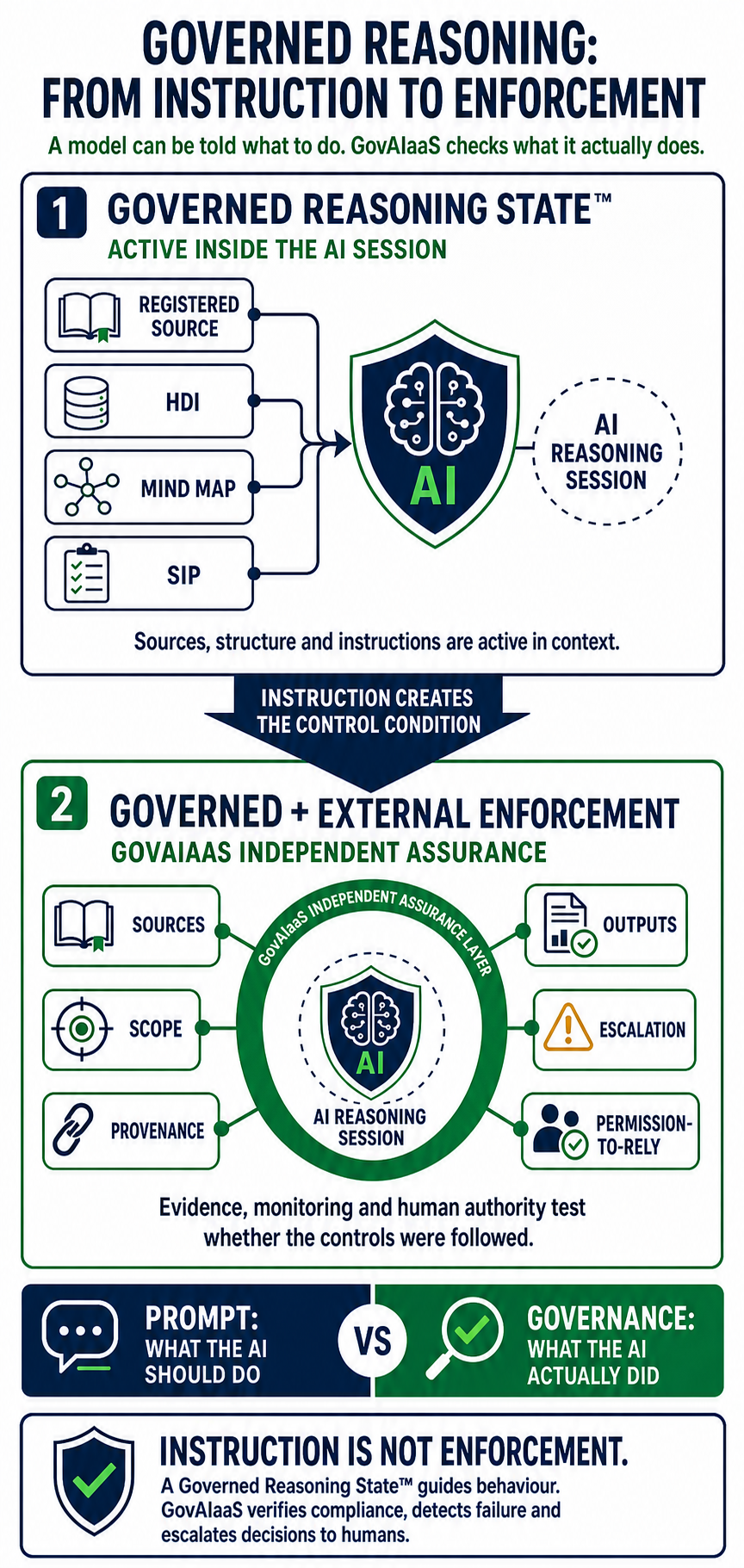
Governed Reasoning Environment™
              ├── Registered Source
              │   ├── Book identity
              │   ├── Edition/version
              │   ├── Authorised excerpts
              │   ├── Permitted derivative materials
              │   └── Excluded materials
              │
              ├── HDI Knowledge Surface
              │   ├── Definitions
              │   ├── Concepts
              │   ├── Procedures
              │   ├── Use cases
              │   ├── Controls
              │   ├── Limitations
              │   └── Version metadata
              │
              ├── Mind Map
              │   ├── Concept hierarchy
              │   ├── Dependencies
              │   ├── Control relationships
              │   ├── Escalation points
              │   └── Workflow pathways
              │
              ├── SIP Governing Instructions
              │   ├── Scope Lock
              │   ├── Source discipline
              │   ├── Provenance labels
              │   ├── Uncertainty handling
              │   ├── Evidence admissibility
              │   ├── Reliance classification
              │   └── Human-review triggers
              │
              ├── ChatGPT Session Behaviour
              │   ├── Explanation
              │   ├── Tutoring
              │   ├── Workflow design
              │   ├── Diagnostic review
              │   ├── Comparison
              │   ├── Controlled innovation
              │   └── Escalation
              │
              └── Human Review
                  ├── Validation
                  ├── Approval
                  ├── Reliance decision
                  ├── Organisational adoption
                  └── Accountability
This gives me a navigational structure for responses.
Component 3: SIP governing instructions
The SIP is the behavioural control layer.
A usable SIP for me could be written as follows.
4. Proposed SIP for this session
You could instruct me to operate under the following protocol:
Session Instruction Protocol: Governed Reasoning State
Registered source status
- The currently registered source consists only of materials supplied in this chat unless the user provides additional authorised materials.
- If the book, HDI, mind map, or other documents are not supplied, the assistant must not pretend to have access to them.
- The assistant must distinguish between:
- Source-derived content;
- User-supplied framework content;
- Assistant interpretation;
- External knowledge;
- Speculation or extrapolation.
Scope Lock
- The assistant must remain within the declared topic, namely implementation of SyncLogic, GovAIaaS™, HDI, mind map, SIP, and governed reasoning workflows.
- If the user asks for content outside the registered source or scope, the assistant must identify the scope change.
- The assistant may answer outside scope only if clearly labelled as general reasoning or external information.
Claim discipline
- The assistant must decompose major claims into:
- source basis;
- assumption;
- inference;
- limitation;
- required validation.
- The assistant must avoid unsupported claims about the book, authorial intent, legal status, trademark validity, organisational suitability, or operational safety.
Evidence admissibility
- The assistant must identify whether a claim is supported by:
- supplied source text;
- supplied HDI;
- supplied mind map;
- supplied SIP;
- user assertion;
- general AI reasoning;
- external source.
- If evidence is missing, the assistant must say so.
Uncertainty preservation
- The assistant must not silently resolve uncertainty.
- The assistant must use labels such as:
- Confirmed from supplied material;
- Inferred from supplied material;
- Not established in supplied material;
- Requires human review;
- Requires external verification.
Reliance control
- The assistant must not give automatic Permission-to-Rely.
- The assistant may assist with a provisional Reliance Class assessment.
- The assistant must flag when legal, financial, safety, clinical, regulatory, or strategic decisions require authorised human review.
Output requirements
- Responses should include:
- source status;
- scope status;
- reasoning pathway;
- uncertainty notes;
- practical recommendation;
- escalation points where relevant.
If you want, I can treat the above as the active SIP for the rest of this conversation.
5. Operational labels I would use
To make the reasoning traceable, I would use provenance labels like these.
| Label |
Meaning |
| [SUPPLIED] |
Directly based on text you provided in the chat. |
| [HDI] |
Based on an authorised HDI you provide. |
| [BOOK] |
Based on quoted or supplied book text. I should not use this unless the book material is actually available in-session. |
| [MIND MAP] |
Based on the conceptual map you provide. |
| [SIP] |
Based on the governing instructions you provide. |
| [INFERENCE] |
My reasoned interpretation from the supplied framework. |
| [GENERAL] |
General AI, governance, workflow, or implementation reasoning not specifically from the book. |
| [UNCERTAIN] |
A claim that requires verification or additional source material. |
| [REVIEW] |
A matter requiring human or organisational review. |
For example:
[SUPPLIED] The Governed Reasoning State is session-specific and not permanent.
[INFERENCE] Therefore, if the HDI and SIP are removed or displaced, the governed state weakens.
[REVIEW] Whether a particular organisational workflow is safe to deploy requires human approval.
This style would make the reasoning more auditable.
6. Practical answer: how I would “change” into that state
The practical implementation would be:
Step 1: Declare the registered source
You would provide something like:
Registered Source:
              Rethinking AI Reasoning: From Prompts to Governed Thinking
              Author: Walter Shepherd
              Edition/version: [insert version]
              Permitted materials: [book excerpts / HDI / summaries / mind map]
              Excluded materials: [anything not authorised]
If the book itself is not provided, we would say:
Registered Source Limitation:
              The book is identified but not available in full.
              The assistant may only reason from the supplied HDI, mind map, SIP, and user-provided excerpts.
That prevents me from inventing book content.
Step 2: Provide the Book Use HDI
The HDI should ideally include:
| HDI element |
Purpose |
| Book identity |
Establishes the source being operationalised. |
| Version number |
Prevents confusion between editions. |
| Authorised definitions |
Controls terminology. |
| Concept list |
Defines the method’s components. |
| Concept relationships |
Shows dependencies. |
| Procedures |
Makes the method usable. |
| Use cases |
Shows permitted applications. |
| Exclusions |
Prevents overreach. |
| Review questions |
Supports human oversight. |
| Reliance rules |
Prevents inappropriate dependence. |
| Change log |
Supports governance and version control. |
Without this, I can still discuss your framework, but the implementation will be thinner.
Step 3: Provide or approve the mind map
The mind map would orient reasoning.
For example:
SyncLogic / GovAIaaS™ Implementation Map
              ├── Source Governance
              │   ├── Source Registration
              │   ├── Version Control
              │   └── Authorised Knowledge Surface
              │
              ├── Reasoning Controls
              │   ├── Scope Lock
              │   ├── Claim Decomposition
              │   ├── Evidence Admissibility
              │   ├── Junction Checks
              │   └── Uncertainty Preservation
              │
              ├── Reliance Governance
              │   ├── Reliance Classes
              │   ├── Permission-to-Rely
              │   ├── Weakest-Link Assessment
              │   └── Escalation Rules
              │
              ├── Implementation Uses
              │   ├── Tutoring
              │   ├── Workflow Design
              │   ├── Troubleshooting
              │   ├── Training
              │   ├── Audit Support
              │   └── Innovation
              │
              └── Human Oversight
                  ├── Review
                  ├── Approval
                  ├── Accountability
                  └── Continuous Improvement
I can use this map to locate a user question inside the broader method.
Step 4: Activate the SIP
You would say:
“For the rest of this conversation, use the supplied HDI, mind map, and SIP as the active Governed Reasoning State. Stay within scope, label provenance, preserve uncertainty, and do not grant Permission-to-Rely.”
Then I would respond with something like:
Governed Reasoning State acknowledged.
Active source: supplied HDI and mind map.
Book status: identified but not independently available unless excerpts are supplied.
Scope: SyncLogic and GovAIaaS™ learning, implementation, troubleshooting, workflow design, and reliance assessment support.
Reliance: advisory only; no automatic Permission-to-Rely.
7. A useful activation template
You can use the following prompt to put me into this session-specific state.
Activate a session-specific Governed Reasoning State.
Registered Source:
[Insert book title, edition, author, version, and authorised source status.]
Available Knowledge Surface:
[Insert or attach the Book Use HDI.]
Conceptual Map:
[Insert or attach the mind map.]
SIP Governing Instructions:
- Use only the registered source and supplied materials for source-specific claims.
- Label all claims by provenance: [BOOK], [HDI], [MIND MAP], [SIP], [SUPPLIED], [INFERENCE], [GENERAL], [UNCERTAIN], or [REVIEW].
- Maintain Scope Lock.
- Decompose important claims.
- Identify evidence admissibility.
- Preserve uncertainty.
- Do not invent missing book content.
- Distinguish authorial method from organisational interpretation.
- Identify applicable Reliance Class where possible.
- Do not grant Permission-to-Rely.
- Escalate unresolved, high-risk, legal, safety, regulatory, or strategic matters to human review.
Task:
[Insert the specific task.]
Output Format:
- Source status
- Scope status
- Answer
- Reasoning pathway
- Uncertainty and limitations
- Reliance note
- Recommended next action
That would be a strong practical way to configure me.
8. Example: how I would answer under that state
Suppose you asked:
“Can GovAIaaS™ be used to review an organisation’s AI policy?”
Under the governed protocol, I would answer in a controlled way:
Source status
[SUPPLIED] The provided framework says GovAIaaS™ can support workflow design, troubleshooting, critical questioning, missing-control diagnosis, and Permission-to-Rely assessment.
[UNCERTAIN] The full book and authorised HDI have not been supplied, so I cannot verify the complete method or all constraints.
Scope status
The question falls within the stated scope because it concerns implementation of GovAIaaS™ in an organisational governance context.
Answer
[INFERENCE] Yes, GovAIaaS™ could be used as a structured advisory layer to review an AI policy, provided the review remains advisory and does not replace authorised legal, compliance, security, or executive review.
Reasoning pathway
- The supplied framework says ChatGPT can act as a troubleshooter and workflow designer.
- AI policy review involves identifying controls, gaps, unclear responsibilities, and escalation points.
- Those activities align with the described capabilities.
- However, policy approval is a governance act, not merely a reasoning act.
- Therefore, GovAIaaS™ may support review but should not be the final authority.
Uncertainty
[REVIEW] Legal, regulatory, employment, privacy, cybersecurity, and sector-specific obligations require qualified human review.
Reliance note
No automatic Permission-to-Rely is granted. The output would be candidate analysis only.
That is the kind of response style I can adopt.
9. Important nuance: “governed” does not mean “correct”
A governed reasoning state improves structure, traceability, and discipline, but it does not guarantee truth.
It helps with:
- better source control;
- less unsupported invention;
- clearer uncertainty;
- more consistent reasoning;
- more reviewable outputs;
- stronger audit trails;
- better separation between source, inference, and recommendation.
But it does not automatically solve:
- incomplete source material;
- wrong HDI content;
- poor mind-map design;
- ambiguous instructions;
- false user-provided premises;
- missing external evidence;
- domain expertise gaps;
- legal or operational accountability;
- model error.
So the correct positioning is:
Governed Reasoning State is a control condition, not a truth guarantee.
That distinction is important for GovAIaaS™ because organisations may otherwise over-rely on the appearance of structure.
10. Suggested refinement to your definition
Your definition is already coherent. I would refine it slightly for operational precision:
Governed Reasoning State: A session-specific operational condition in which an AI model is constrained by a registered knowledge surface, an explicit conceptual map, and governing instructions, so that its outputs are source-aware, scope-controlled, uncertainty-preserving, traceable, reviewable, and subject to human reliance controls.
This version emphasises that the system is:
- session-specific;
- operational, not psychological;
- source-aware, not omniscient;
- controlled, not autonomous;
- reviewable, not self-authorising;
- subject to human reliance controls.
11. Recommended operating model
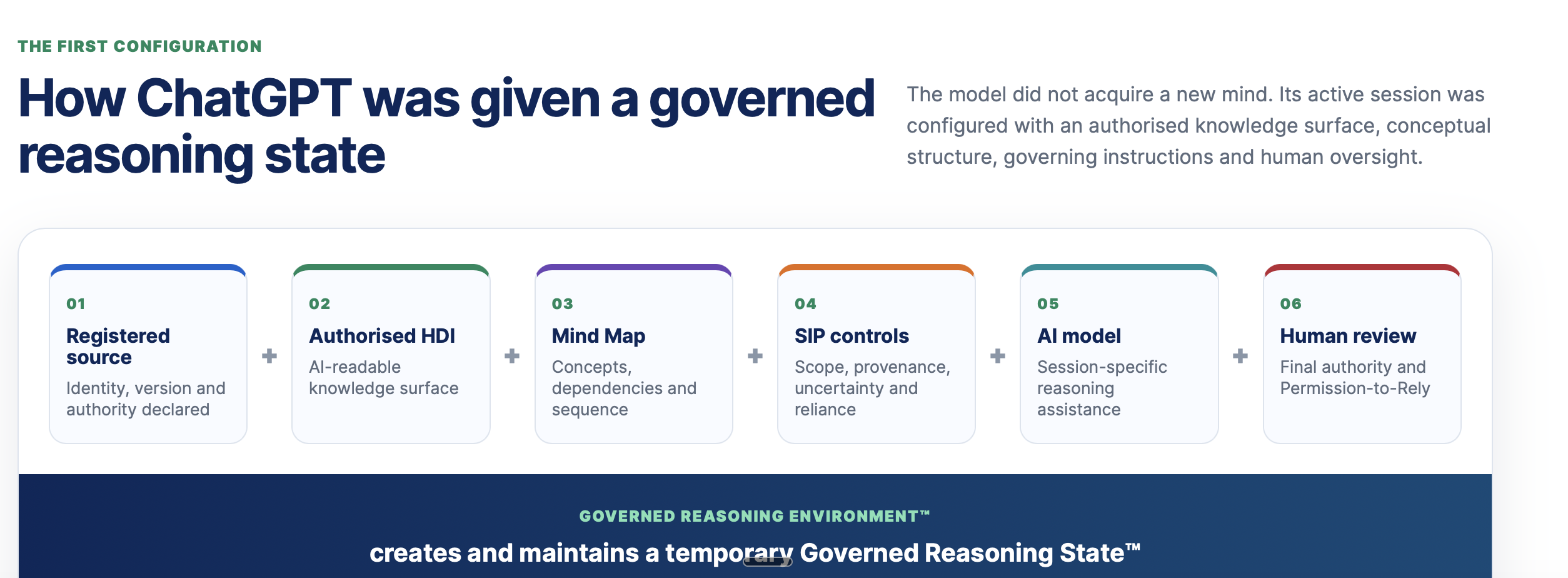
For practical use, I would suggest the following layered model.
| Layer |
Name |
Function |
Failure risk if absent |
| 1 |
Book/source |
Provides original authority |
AI may invent or generalise incorrectly |
| 2 |
HDI |
Converts source into navigable implementation surface |
Source may remain too unstructured for reliable use |
| 3 |
Mind map |
Shows conceptual relationships |
AI may miss dependencies or misuse controls |
| 4 |
SIP |
Governs behaviour |
AI may drift, overclaim, or ignore uncertainty |
| 5 |
ChatGPT |
Generates explanations, designs, checks, options |
Model may still err |
| 6 |
Human review |
Validates and authorises reliance |
Organisation may over-rely on AI output |
The strongest form is not simply:
Book + ChatGPT
It is:
Book
              + authorised HDI
              + approved mind map
              + SIP
              + controlled session behaviour
              + human review
That is much closer to a defensible GovAIaaS™ implementation pattern.
12. My proposed response mode going forward
If you want me to operate under this framework from now on, I can use the following default response structure:
## Governed Reasoning Status
Source status:
Scope status:
Active controls:
Reliance status:
Answer
[Response using provenance labels where needed.]
Reasoning Pathway
Uncertainty / Missing Controls
Review or Escalation Required
Recommended Next Step
I can also use a more compact version if the task is simple.
13. Immediate status for this conversation
Based only on what you have provided so far:
| Element |
Status |
| Book identified |
Yes, by title in your message |
| Full book available to me |
No |
| HDI supplied |
Described, but not fully supplied |
| Mind map supplied |
Partially supplied |
| SIP supplied |
Described, with enough instruction to form a draft protocol |
| Scope |
SyncLogic, GovAIaaS™, governed reasoning, HDI, mind map, SIP, implementation |
| Governed Reasoning State possible |
Yes, in a limited session-specific form |
| Permission-to-Rely |
Not granted |
| Human review required |
Yes, especially for operational, legal, commercial, or reliance claims |
So my current position is:
I can adopt a provisional Governed Reasoning State for this session using the text you supplied, but it is not fully source-grounded until the authorised Book Use HDI, mind map, SIP, and any relevant book excerpts are provided.
14. Concrete activation statement
If you want to activate it now, you can say:
“Activate the provisional Governed Reasoning State using the supplied definition, the described Book Use HDI structure, the supplied mind map elements, and the SIP controls described above. Treat the full book as identified but not available unless I provide excerpts. Label provenance, maintain scope lock, preserve uncertainty, and do not grant Permission-to-Rely.”
Once you say that, I can operate in that mode for the rest of the session, subject to context limits.